



/Website/Website%20Images/icons/leadership.svg)


Grocery Retail Agilence News Restaurant General
 Agilence Staff
.png?width=900&height=600&name=LPMM%20Social%20Posts%20(Website).png)
Loss prevention has always been defined by pressure.
But the pressure LP leaders are managing today is different in kind, not just degree.
Shoplifting incidents have nearly doubled since 2019. Nearly three in four retailers report increasingly violent behavior during theft events. Organized retail crime has matured into coordinated, multi-location networks — sophisticated operations that use online marketplaces to liquidate stolen goods faster than most LP teams can build cases. Meanwhile, self-checkout expansion and staff shortages have opened new attack surfaces for both opportunistic and organized theft. And the shift to omnichannel has added BOPIS fraud, cross-channel returns abuse, and digital payment fraud to a threat landscape that traditional LP workflows were never designed to address.
Long-standing loss vectors haven't gone anywhere either. Internal theft, returns fraud, vendor fraud, administrative errors, loyalty scheme abuse — each requires different detection methods and different data. The result is an LP complexity that has expanded faster than most organizations' capacity to respond to it.
That alone would be enough to strain any LP program. But the operating environment has compounded it. Tight margins, short-staffed stores, high turnover, and sustained pressure on earnings mean LP teams are being asked to cover more ground with the same headcount… or less.
Technology has become the primary lever for scaling LP effectiveness. The problem is that the technology landscape has become its own source of confusion.
With dozens of vendors and hundreds of point solutions available, LP leaders face a new kind of challenge: not just managing threats, but navigating a market that generates more noise than signal. The teams that were designed to catch shoplifters are now being asked to evaluate AI platforms. They need a better framework for doing that.
The Modernization Dilemma
Technology adoption in loss prevention is accelerating. A 2025 study found that 87% of retail leaders cite Gen AI and automation as important to their loss prevention efforts. Exception-based reporting, computer vision, RFID, and predictive analytics are no longer theoretical — they're on procurement lists across the industry.
But adoption and alignment are different things. What's actually happening in most organizations is fragmented: a computer vision pilot at a handful of SCO lanes, an analytics platform that isn't fully integrated, AI features in a vendor platform that nobody can quite explain. "AI-powered" has become a marketing phrase so common it has stopped conveying information. Most LP leaders can't distinguish genuine machine learning capabilities from rebranded automation and the vendor landscape doesn't make it easy.
The deeper problem isn't vendor complexity. It's that loss prevention lacks a shared language for modernization. Without a common framework for understanding where LP programs are today and where they should be going, leaders can't benchmark their own capabilities, can't evaluate vendor claims with confidence, can't build a coherent case for investment, and can't develop a realistic roadmap for the next three to five years.
That's the gap the Loss Prevention Maturity Model was built to close.
Introducing the Loss Prevention Maturity Model
Originated by Agilence COO Brian Brinkmann, the Agilence team developed the Loss Prevention Maturity Model (LPMM) to map the evolution of LP technology across four distinct stages: Devices → Analytics → AI → Agentic AI.
Each stage represents a meaningful step in how LP programs generate, interpret, and act on information. Each has specific characteristics, defined technological requirements, and clear advancement criteria. The model gives LP leaders a structured way to understand where they are, where they're going, and what it takes to move forward.
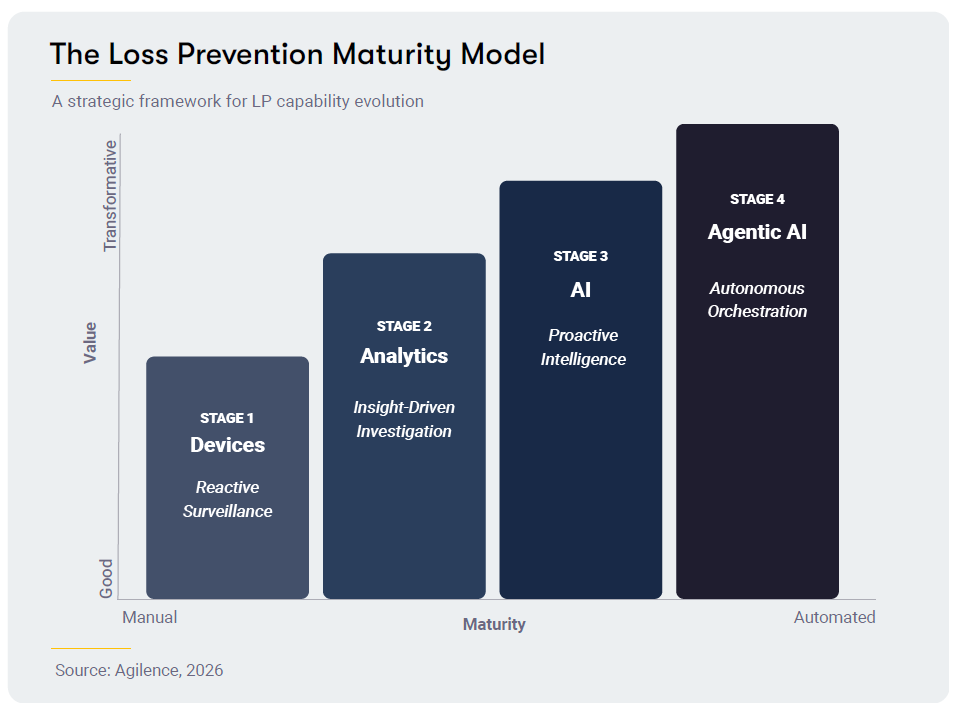
A quick orientation on what each stage means at a glance:
- Devices answer what happened.
- Analytics answer why it happened.
- AI answers what to focus on.
- Agentic AI completes the loop by executing what needs to be done.
These stages build on each other but critically, they don't replace each other. The model is cumulative, not sequential. Organizations that advance to Stage 3 still rely on their Stage 1 devices. Intelligence from later stages flows back to inform earlier ones. The progression is about adding capability and elevating how existing tools are used, not discarding them.
Want to see the full model? Read the whitepaper here
Walking Through the Four Stages
Stage 1 — Devices: Reactive Surveillance
Every LP program starts here. Cameras, point-of-sale terminals, EAS systems, RFID sensors, access controls — the physical layer that establishes visibility into what's happening in stores.
Devices answer a single essential question: what happened? A camera captures an incident. A POS terminal records a transaction. An EAS alert flags a tagged item leaving the floor. These tools generate the raw data that every subsequent stage depends on.
The limitation of Stage 1 isn't the technology — it's the workflow. Device-centric LP is reactive and event-driven: an incident occurs, and someone investigates manually. That model doesn't scale. As retail operations grow more complex and transaction volumes rise, the amount of data generated by physical devices outpaces the human capacity to review it. Signals are abundant; synthesis is limited.
Stage 1 never becomes obsolete. Cameras, locked cases, and EAS tags remain essential at every maturity level. What changes in later stages is how devices are deployed and how their outputs are consumed. In later stages, they become guided by intelligence that only becomes available once the data they generate is actually integrated and analyzed.
Stage 2 — Analytics: Insight-Driven Investigation
Most LP organizations operate at Stage 2 today. The defining move from Stage 1 to Stage 2 is integration: bringing together POS data, video, HR records, inventory, audit results, and other sources into a unified analytics environment where patterns can be found.
Exception-based reporting (EBR) was the breakthrough that made this possible, giving LP teams the ability to mine transactional data across entire store chains from a single platform, rather than investigating locations one at a time. The result was a fundamental shift in the LP/AP's role from a store-level reactive responder to an analyst and pattern detective.
At Stage 2, LP teams can answer not just what happened, but why. Which associate? Which store? Which time window? Which scheme? Analytics surface the anomalies and analysts open cases and investigate them.
The structural limitation of Stage 2 is that the analyst’s attention remains the bottleneck. There are not enough good analysts, and each analyst only has so much time and attention. Alert volumes can exceed investigation capacity. Rules that catch this quarter's schemes miss next quarter's variations. Insight generation still depends on human bandwidth — which means it doesn't scale without adding people. Organizations are ready for the next stage when analysts are spending more time managing alerts than investigating cases.
The good news is that the timing is right: machine learning models that automatically prioritize alerts or score risk — tools that didn't exist at scale just a few years ago — are now reaching the market in meaningful ways (including within Agilence Analytics). The shift to Stage 3 is being enabled by a new generation of AI technology that makes what wasn't previously practical now achievable.
Stage 3 — AI: Proactive Intelligence
Stage 3 changes the fundamental question LP teams are trying to answer. Instead of searching for problems, teams at this stage are responding to prioritized recommendations surfaced by AI models. The analyst's job shifts from finding issues to evaluating and acting on them, a change that scales LP effectiveness without adding headcount.
AI is the most hyped technology in software right now and LP is not immune. "AI-powered" solutions are abundant, but what does that term really mean? AI claims cover an enormous range of actual capability, from basic automation to genuine machine learning. For LP leaders trying to evaluate tools and make investment decisions, it can be difficult to unpack. For LP analysts, there's a different question underneath it: what does AI mean for my job? The whitepaper addresses both.
AI in LP is not a monolith — it's a set of distinct capabilities at different maturity levels. The whitepaper breaks these into four categories: Seeing (computer vision at self-checkout and LPR), Thinking (machine learning that scores risk and prioritizes alerts), Understanding (NLP that surfaces patterns across case notes and incident reports), and Advising (AI that recommends specific actions). Each operates differently, delivers different outcomes, and requires different organizational readiness.
This taxonomy is a practical filter for evaluating what vendors are actually offering, and the whitepaper goes into detail on each one.
Stage 4 — Agentic AI: Autonomous Orchestration
Stage 4 looks toward the future of loss prevention. While LP organizations aren't operating here yet, the broader technology landscape is beginning to move in this direction — in sectors like cybersecurity, financial operations, and IT service management, AI systems are starting to execute multi-step workflows and initiate actions autonomously, within defined guardrails. These systems are commonly referred to as "agentic" or Agentic AI.
Picture a system that, on detecting a coordinated ORC pattern across three stores, compiles the evidence, drafts the case file, flags the right investigator, and alerts store leadership — all before an analyst has opened their inbox. That's the direction the technology is moving, though getting there responsibly will take time.
What this eventually looks like in LP — how much autonomy is practical, how close any of it actually is, and what the path there requires — is something the whitepaper explores in depth, including a framework called the Spectrum of Agency that maps the full range of autonomy in computer systems.
Why This Model Matters Now
The LPMM is a practical tool for LP leaders who are being asked to do more with less, evaluate an increasingly noisy vendor market, and build coherent modernization roadmaps that executives will fund.
With the model, leaders can benchmark where their program currently stands honestly with defined operational characteristics and how they can advance. They can evaluate vendor capabilities with a clearer filter: does this move us meaningfully forward, or does it add a tool that doesn't connect to anything? They can build investment cases grounded in the business value each stage delivers, rather than vague appeals to innovation.
Loss prevention is not a cost center; it is a margin multiplier. Every dollar recovered flows directly to the bottom line. Every fraud pattern identified prevents future losses. Every operational inefficiency surfaced by LP analytics creates value beyond shrink reduction. As LP systems mature, they’ve become strategic data hubs capable of informing decisions far beyond asset protection — inventory accuracy, labor allocation, workforce management, supply chain, and more.
The LPMM provides a framework for helping to capture that value systematically. And it starts with an honest read of where you are today.
Want the full model? Download the whitepaper for the complete stage deep-dives, the AI taxonomy, the Spectrum of Agency, the Four Foundations framework, and stage-transition playbooks for each advance.
Ready to Learn More?
The Loss Prevention Maturity Model whitepaper is available now.
Prefer to see it presented? Agilence COO Brian Brinkmann walks through the model in this on-demand webinar with the Loss Prevention Foundation.
Want to see which stage your LP program falls under and how to advance?
Take the assessment
Related Articles

Agilence Becomes Newest Master Level Partner with Loss Prevention Foundation (LPF)
(Matthews, NC – February 14, 2020) The Loss Prevention Foundation (LPF) announced that Agilence, Inc. has advanced its partne...
Remembering Gus Downing: A Loss Prevention Pioneer
It is with heavy hearts that we at Agilence mourn the passing of Gus Downing, a true luminary in the loss prevention (LP) and...
How can Leaders Really Measure the Impact of Loss Prevention Efforts?
In LPM’s recent survey, Evolving Perception of Value within Loss Prevention Departments, diverse opinions indicate the percep...Subscribe to our blog
Receive free educational resources like exclusive reports, webinars, and industry thought leadership articles straight to your inbox.