



/Website/Website%20Images/icons/leadership.svg)


General
 Agilence Staff
.png?width=900&height=600&name=generated-image%20(8).png)
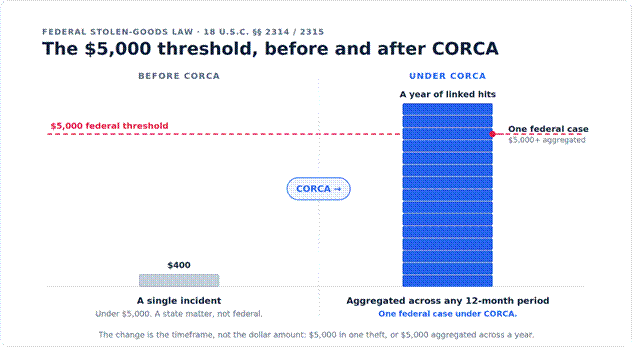
A booster walks out with $400 in merchandise. Three times a week. Across a dozen stores in three states. Each individual hit stays under the state felony threshold, and none of it clears the $5,000 single-incident bar that turns theft into a federal case. ORC crews know the math and for years the math has protected them.
The Combating Organized Retail Crime Act (CORCA) is written to erase that gap. On May 12, 2026, it passed the U.S. House of Representatives 348 to 60. It now sits in the Senate, where Judiciary Chairman Chuck Grassley and Ranking Member Dick Durbin have filed it as an amendment to the National Defense Authorization Act. It is not law yet. But a bill that clears the House by that margin, backed by 38 state attorneys general and more than 260 businesses, is not one that loss prevention teams should wait on.
Here is the part that matters for your team. The provision that gives CORCA its teeth only works if someone has already done the documentation. In most cases, that someone is LP, and the evidence lives in your case management system.
The federal math of ORC just changed
Federal stolen-goods law has not kept pace with how ORC crews actually operate. Under 18 U.S.C. Sections 2314 and 2315, theft generally becomes a federal matter only when a single incident involves $5,000 or more in stolen goods. Professional crews exploit this by keeping each hit small, staying beneath both the federal bar and state felony thresholds.
CORCA changes one thing with outsized consequences. Prosecutors can aggregate the value of stolen goods across any 12-month period to reach the $5,000 threshold. A year of $400 hits, tied to the same actor or crew, becomes a single federal case. The R Street Institute described the effect as letting strings of smaller thefts tied to one network be charged as a single federal matter.
The retailers who will benefit are the ones who can document, connect, and preserve twelve or more months of incident-level case data. The law creates the opportunity. Your records decide whether you can use it.
What the CORCA Act does beyond aggregation
Aggregation is the headline, but the bill is broader. Four other provisions reshape how ORC networks can be pursued:
- Online fraud is now in scope. The theft statutes extend to anyone using a facility of interstate or foreign commerce, language that captures online marketplaces, payment platforms, and the communication tools crews use to move and monetize stolen goods. Physical transport across state lines is no longer the only jurisdictional hook.
- Gift card and prepaid card fraud is targeted directly. These are among the fastest-growing monetization channels for ORC and Homeland Security Investigations has already documented transnational groups exploiting gift cards to launder money.
- Stolen-goods offenses become money laundering predicates. Laundering the proceeds of organized theft becomes its own federal felony, which lets prosecutors reach the finance layer of a network: the people who never touch merchandise but move the money.
- Criminal forfeiture attaches to proceeds. Vehicles, warehouses, storefronts, and bank balances traceable to a theft operation become reachable, which removes the economic engine behind the crews.
The bill also creates a national Organized Retail and Supply Chain Crime Coordination Center inside Homeland Security Investigations, with a statutory duty to build relationships with retailers and share information. For LP teams, that last detail is not abstract. It means a federal center may eventually ask you for your ORC picture and the quality of your answer will depend on the quality of your case data.
Why federal ORC cases will be built in your case management system
Federal prosecutors can only prosecute what someone has documented. A $5,000-over-12-months case is, in practice, a stack of incident reports: dates, locations, merchandise, dollar values, suspect identifiers, video references, and witness statements, all tied to a common actor or crew. If that data is siloed by store, purged after 90 days, or trapped in spreadsheets, the aggregation provision does nothing for you.
Case management systems stop being back-office record-keeping and become where federal cases are won or lost. Not every system clears that bar. Five capabilities separate a prosecution-ready case system from a digital filing cabinet:
|
Capability |
Why it matters under CORCA |
|
Retention |
Keep every incident, photo, and valuation for the full aggregation window and beyond. Anything purged inside twelve months is federal evidence destroyed, and investigations often open after the window closes. |
|
Linking |
Connect scattered incidents to a common actor or crew across stores, banners, and states. Linkage is what turns a set of misdemeanors into one aggregate federal case, and what prosecutors weigh when deciding which cases to take. |
|
Mapping |
Visualize where and when a crew operates. Geography across state lines is the interstate nexus a federal case requires, made visible. |
|
Valuation |
Attach a documented dollar value to every incident. A defensible aggregate total is built from valued incidents, not estimated after the fact. |
|
Export |
Produce a clean, structured case file on demand. When a task force or the federal Coordination Center asks for your ORC picture, the answer should be an evidence-grade export, not a shared drive. |
The question for any LP leader is simple: can your current system do all five?
Why Agilence Case Management
Agilence Case Management was built to clear that bar. It delivers all five capabilities, and two things in particular set it apart for CORCA.
The first is storage. Agilence Case Management has no case caps, no retention tiers, no per-case limits. The single biggest CORCA liability, evidence purged before a prosecutor can reach it, simply does not arise. A year of linked incidents stays intact, and so does the fifth year.
The second is the money trail. Agilence's roots are in exception-based reporting, so it captures something the five-capability bar never asks for: how the theft gets converted to cash. Gift card conversions, refund fraud, and other POS anomalies tie straight to the case file, documenting the finance layer that CORCA treats as a money laundering predicate. A prosecutor gets the theft and the laundering in one record. See how Agilence Case Management keeps every incident, photo, valuation, and dollar trail connected and prosecution-ready.
Learn more about Agilence Case Management
CORCA Act FAQ
Is the CORCA Act law?
Not yet. It passed the House 348 to 60 on May 12, 2026, and is pending in the Senate, including as a filed amendment to the National Defense Authorization Act. It has not been signed.
Does CORCA require retailers to do anything?
No. Every mandate in the bill falls on federal agencies, mainly DHS and DOJ. For retailers, the relevance is opportunity, meaning federal prosecution of cases that were previously too small, and information sharing with the new Coordination Center.
What is the aggregation change in one sentence?
Federal stolen-goods charges can be based on $5,000 or more in aggregate value across any 12-month period rather than $5,000 in a single incident.
Does it cover online fencing?
Yes. The statutes extend to the use of any facility of interstate or foreign commerce, which covers online marketplaces and payment platforms.
Will prosecutors really pursue a $5,000 case?
Selectively. The Congressional Budget Office expects only a small number of people to face penalties or forfeiture under the bill. Discretion will favor well-documented network cases, which is the practical argument for rigorous case management.
What are the odds it becomes law in 2026?
A strong House margin, bipartisan Senate sponsorship, leadership backing, and a must-pass legislative vehicle argue in favor. Organized opposition, limited Senate floor time, and the amendment process argue for caution.
Is there a related law already in force?
Yes. The INFORM Consumers Act, effective June 2023, requires online marketplaces to verify high-volume third-party sellers, defined as 200 or more sales and at least $5,000 in revenue over a 12-month period.
Related Articles

10 Topics to Include in your Retail Business Health and Safety Manual
An up-to-date safety manual is essential to keep employees, customers, and your business safe from harm. Instead of just keep...
How Loss Prevention Can Respond to Rising Gun Violence in Retail & Restaurants
Gun violence in retail and restaurants is a growing concern for loss prevention (LP) and security professionals. Between 2016...
5 Tips to Improve Restaurant Performance
Table-service restaurants serve as a reunion or gathering spot for family, friends and coworkers alike, while quick-service e...Subscribe to our blog
Receive free educational resources like exclusive reports, webinars, and industry thought leadership articles straight to your inbox.