

Loss prevention teams are being asked to cover more ground than ever, usually without more people to do it. Finding exceptions isn't the hard part anymore. Most LP teams can already see far more flagged activity than they have time to work.
The hard part is what happens after the flag. The people best positioned to act on most of those exceptions are already in your field: the store, district and regional managers who know their locations, their people and their registers.
LP's scope keeps growing
LP isn't just LP anymore. In an April 2026 benchmarking study of 58 retailers across 14 countries, ECR Retail Loss found that 54% of loss prevention teams now operate with a broad or very broad remit, taking in operations, people, safety, and more. Only 15% still focus on core loss prevention alone.
The ground is widening too. The same study found that 47% of retailers now manage loss end to end, across stores, distribution centers and online fulfillment.
In practice, a single LP team might own all of this:
- Organized retail crime, shoplifting and boosting
- Employee theft, refund and return fraud, and gift card fraud
- Self-checkout loss, plus e-commerce and BOPIS fraud
- Cash and till variances, and vendor and delivery fraud
- Violence and store safety
- Investigations, store audits, CCTV review and shrink reporting
The workday only has so many hours. The urgent work fills the day, and the routine but important work, like exception reports, slides to tomorrow. Then to the day after.
The field team is the answer
You can't hire your way out of a bigger remit. But you can split the work differently. Keep your analysts on the complex cases that need their expertise, like ORC, investigations and shrink reporting. Send the routine exceptions to the people closest to them.
A store manager reviewing a price override at their own register has context no central analyst has. They know the cashier, the shift and the customer. Most of the time, they can tell a legitimate override from a problem in a minute or two.
It doesn't have to stop at the field. Finance can confirm what happened with cash. HR can weigh in on staffing. Marketing can see why a promotion isn't landing the way it should. The point is the same: get each exception in front of the person who can actually resolve it.
Why the field gets left out
If the field team is the answer, why aren't more LP programs using them? We hear the same three reasons repeatedly.
- There's too much to wade through. Exception analytics are built for analysts. A full analytics tool carries far more than a store manager needs, so many LP leaders keep field managers out entirely rather than risk overwhelming them.
- The work moves through spreadsheets and email. When the field does get pulled in, it usually happens through exports and inboxes. That creates more work for LP, and details get lost along the way. When something needs escalating, the next person starts over, pulling the transactions and the video again.
- There's no record. Once review happens outside the system, it's hard to say who looked at what, what they found, or whether a location was reviewed at all. Two managers looking at the same alert type may handle it two different ways, and coverage depends on who happens to be diligent.
How Agilence Signal brings the field in
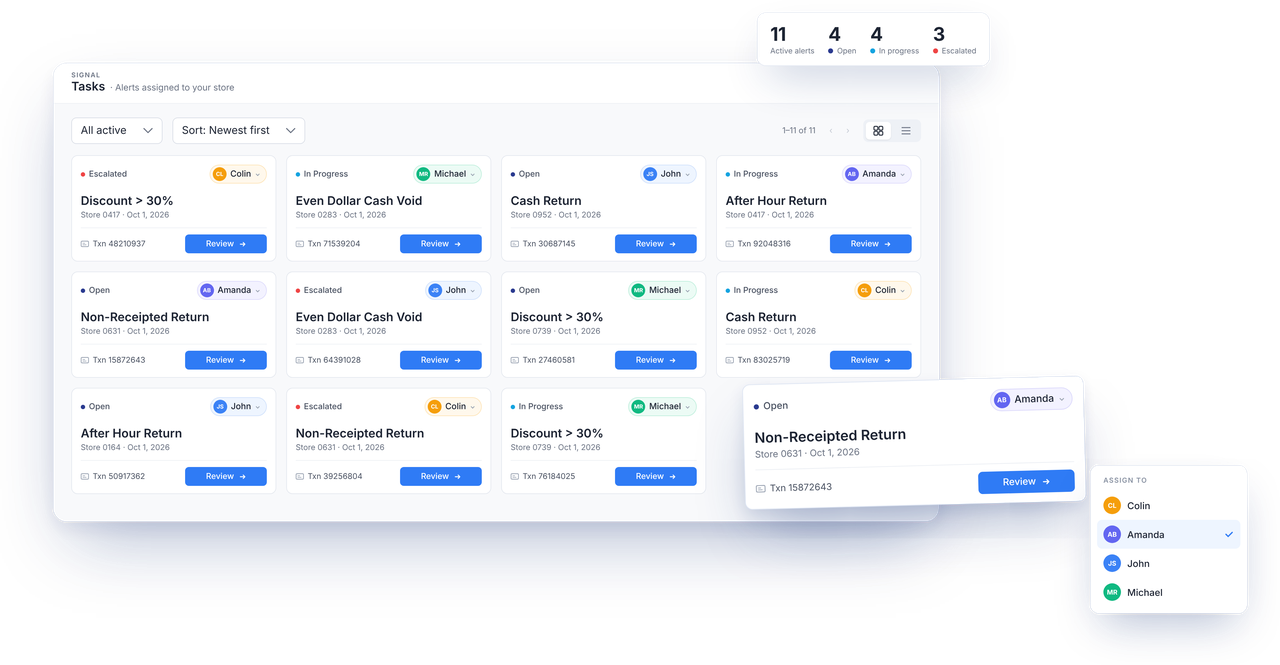
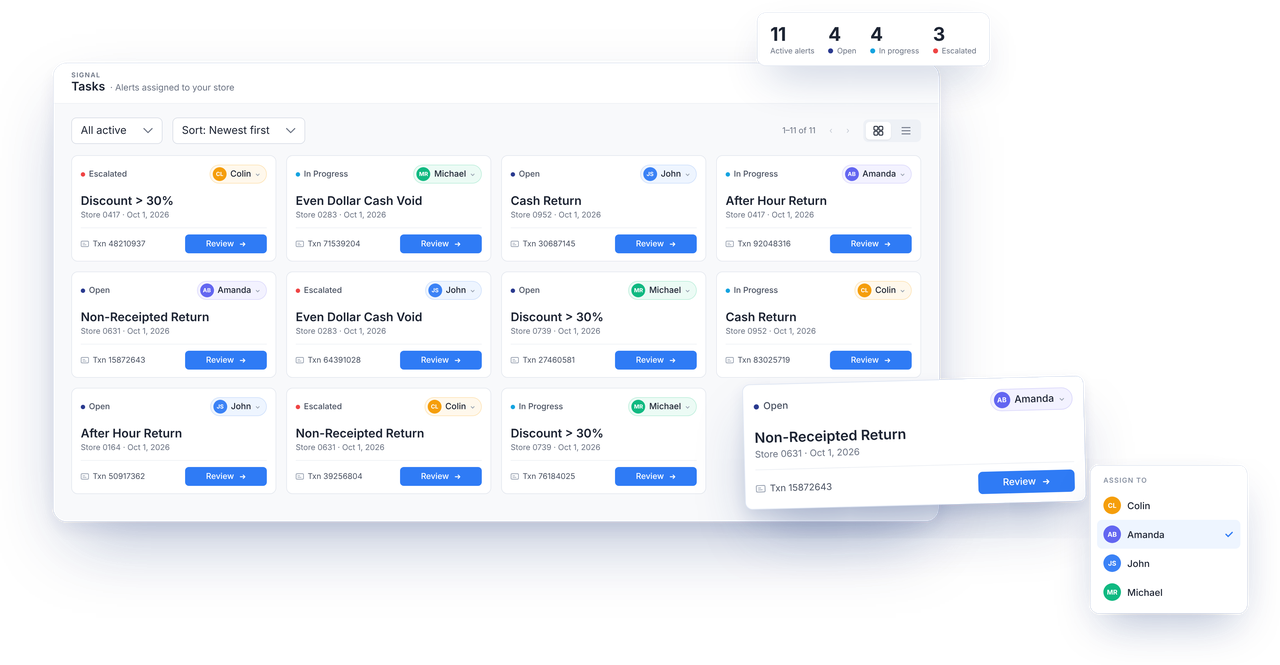
Signal is part of Agilence Analytics, built for the people closest to the activity. Analytics shows you where to look. Signal turns those flags into simple, guided tasks for the people you choose.
Here's how an exception moves from flag to recorded outcome:
- Flag. Your Analytics rules catch the exception, the same way they do today.
- Route. It becomes a task in the queue of the manager responsible for that location.
- Review. Receipt detail and video sit side by side, guided by a step-by-step plan.
- Decide. The manager answers the review questions, then closes it out or escalates it.
- Record. The outcome, cause and resolution sync back to Analytics.
Each piece answers one of the barriers above.
A focused queue, not a full analytics tool. Every field user sees only the flagged transactions for the locations they're responsible for. A store manager sees their store. A district or regional manager sees their district or region. Price overrides, cash refunds, no-receipt returns, discount stacking: whatever your LP team already watches for, each person sees only what's theirs.
Everything needed to decide, on one screen. Each task opens with a clear plan. The transaction detail shows the cashier, terminal, item, and the pricing detail that triggered the alert. With a video integration, footage plays alongside it, and a jump-to-transaction control takes the manager straight to the moment it happened.
The same review, in every location. LP builds the review questions once and attaches them to an alert type. Every location answers them the same way, and comments, notes, cause and resolution stay with the task.
Escalation with context attached. When something looks wrong, the transactions, video and the manager's notes travel with the escalation to the district manager or LP team. Nobody starts the investigation over.
You decide who sees what. Tasks only go to the people you choose, based on the rules you set. If a manager is the subject of an investigation, that task never reaches them.
Coverage you can finally measure. Because review happens in the system rather than beside it, every task ends with a recorded outcome. You can see how much flagged activity was actually reviewed, how consistently across locations, and how quickly real issues escalate. That feedback helps you tune your alerting over time.
No new data, no new login
Signal is built in, not bolted on. It works the alerts your Analytics rules already create, so there's no new data feed, no new integration and no implementation data project. Monitors are still built and managed in Analytics, and updates in either place show in the other.
Field users sign in with their Agilence login. Admins choose whether each user sees Analytics, Signal, or both.
Close the loop between analytics and action
LP's remit isn't going to shrink. The teams that keep up will be the ones that put every exception in front of the person best placed to resolve it, and keep a record of what happened next.
Signal makes that practical. It's built for the field, it's part of Agilence Analytics, and it closes the loop between the analytics your LP team runs and the action your field team takes.
Already an Agilence Analytics customer? Talk to your account team about turning on Signal.
New to Agilence? Signal comes with Agilence Analytics, so request a demo to see both in action.